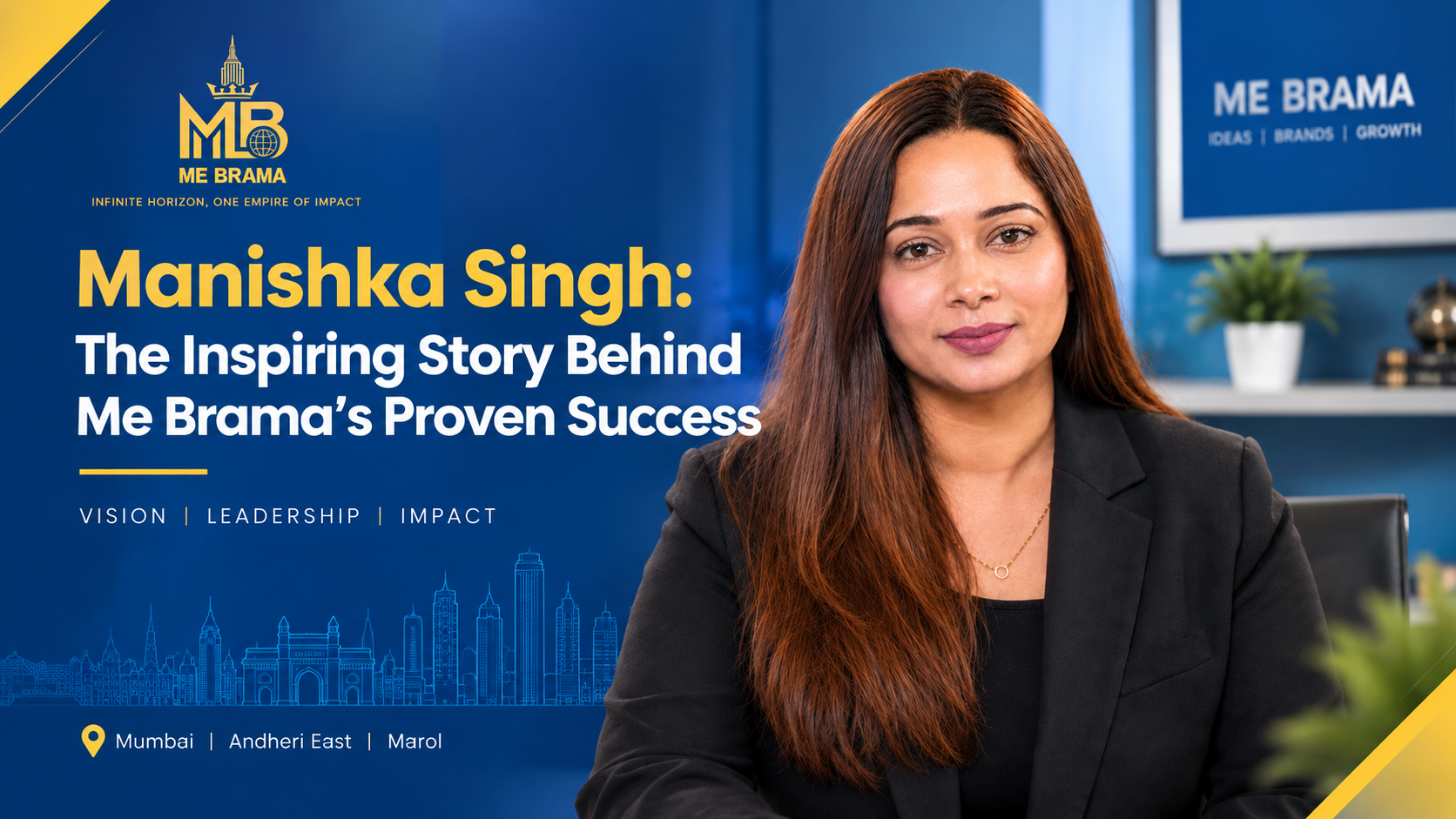
Manishka Singh is what today’s article is all about — here’s what Mumbai business owners need to know.
Working with dozens of early-stage businesses across Andheri East, Marol, and Mumbai has given Me Brama founder Manishka Singh a clear view of the mistakes that trip up new businesses again and again. Here, she breaks down the five most common ones — and what to do instead.
Manishka Singh: Mistake 1: Trying to Be Everywhere at Once
New founders often feel pressure to have a presence on every platform — Instagram, Facebook, LinkedIn, YouTube, Twitter — simultaneously. In practice, this usually results in mediocre, inconsistent content spread too thin to build real traction anywhere. Manishka’s advice: pick the one or two platforms where your actual target customers spend time, and build genuine consistency there before expanding further.
Mistake 2: Launching Paid Ads Before Fixing the Website
A common and costly mistake is spending on Google Ads or social media ads that drive traffic to a website with a weak or confusing conversion pathway — no clear call-to-action, a complicated contact form, or slow load times. The result is wasted ad spend on visitors who never had a real chance to convert. Manishka recommends fixing the website foundation first, even if it means delaying paid campaigns slightly.
Mistake 3: Ignoring Local SEO in Favor of Broad Targeting
Many startups, eager to appear ambitious, focus their SEO and advertising efforts on broad, highly competitive keywords rather than realistic, local, high-intent searches. For a new Marol or Andheri East business, this usually means competing against much larger, better-funded competitors for terms that are far harder to win — while ignoring lower-competition local searches that would actually convert faster.
Mistake 4: Treating Marketing as a One-Time Setup Instead of an Ongoing Process
Founders sometimes approach digital marketing the way they’d approach building a website — a project with a clear start and end. In reality, effective marketing requires ongoing attention: content needs to be published consistently, ad campaigns need continuous optimization, and SEO requires regular maintenance as algorithms change. Startups that treat marketing as “done” after initial setup often see early gains fade within months.
Mistake 5: Not Tracking the Metrics That Actually Matter
It’s easy for a new business to get excited about follower counts or website traffic numbers without connecting them back to actual business outcomes — leads, calls, or sales. Manishka emphasizes that every startup should be able to answer a simple question at any point: how much revenue or how many qualified leads has our marketing spend actually generated? If that question is hard to answer, it usually means tracking needs to be fixed before spending increases further.
Why These Mistakes Are So Common
Most of these mistakes come from the same underlying pressure: startups often feel they need to move fast and show activity across every channel simultaneously, rather than building a focused, sustainable strategy. Manishka’s experience working with early-stage businesses across Mumbai suggests the opposite approach tends to work better — narrower focus, stronger execution, and patience to let compounding channels like SEO and content build over time.
How to Course-Correct If You Recognize These Mistakes
If your startup has fallen into one or more of these patterns, the good news is that all of them are fixable without starting from scratch:
- Audit your current channels and identify which ones are genuinely driving results versus which are just consuming time without a clear return.
- Review your website’s conversion pathway before increasing ad spend further.
- Shift some keyword and ad targeting toward realistic, local, high-intent terms rather than only broad, competitive ones.
- Build a simple, sustainable content and campaign calendar rather than sporadic bursts of activity.
- Set up clear tracking so every marketing decision can be evaluated against real business outcomes.
A Founder’s Perspective on Getting It Right
Manishka Singh often points out that these mistakes aren’t a reflection of founders being bad at marketing — they’re a natural result of trying to do too much, too fast, without dedicated expertise. This is exactly the gap Me Brama was built to fill: bringing focused, experienced strategy to startups that would otherwise be learning these lessons the hard way, through wasted budget and missed opportunities.
How Me Brama Helps Startups Avoid These Pitfalls
Working with early-stage Mumbai businesses, Me Brama’s process typically starts with an audit specifically designed to catch these common mistakes before they compound — reviewing website conversion pathways, current ad account structure, keyword targeting, and tracking setup, then building a realistic, prioritized plan from there.
Mistake 6: Copying Competitors Instead of Understanding Your Own Customer
A subtler but equally costly mistake Manishka Singh sees regularly is founders reverse-engineering their strategy purely from what a competitor is doing, rather than starting from their own customer’s actual behaviour. A new restaurant in Andheri East copying a competitor’s Instagram aesthetic, for instance, might be mimicking a strategy built for a completely different customer base or price point. Manishka’s advice is to treat competitor research as one input among several, not a blueprint to be copied wholesale.
Mistake 7: Underestimating How Long Genuine Trust Takes to Build
Startups often expect a single strong campaign to immediately convert skeptical customers into loyal buyers. In reality, particularly for higher-consideration purchases, most customers need multiple touchpoints – seeing a business mentioned locally, reading reviews, visiting the website, and finally converting – before making a decision. Manishka encourages Marol and Andheri East founders to plan marketing budgets around this realistic, multi-touch customer journey rather than expecting one-off campaigns to do all the work.
The startups that struggle most aren’t usually the ones with the smallest budgets – they’re the ones expecting a small budget to move as fast as a much bigger one. Realistic expectations, matched to your actual resources, save founders an enormous amount of frustration, says Manishka Singh, Founder of Me Brama.
How These Mistakes Show Up Differently by Industry
Manishka notes that while the five core mistakes apply broadly, they show up differently depending on the type of startup. A D2C brand in Mumbai is more likely to overspend on paid ads before nailing organic content and conversion rate optimization. A B2B startup in Marol’s manufacturing sector, by contrast, is more likely to underinvest in SEO entirely, wrongly assuming their buyers don’t search online before making purchasing decisions – when in reality, procurement teams increasingly research suppliers via Google long before making direct contact.
A Practical Framework for New Founders
For founders trying to avoid these mistakes from the outset, Manishka recommends a simple sequencing framework: fix the website conversion pathway first, establish basic local SEO and Google Business Profile presence second, and only then layer on paid advertising and broader content strategy. This order matters because each step compounds the effectiveness of the ones that follow – paid traffic sent to a broken website wastes money, and content published without SEO foundations struggles to be discovered in the first place.
Frequently Asked Questions
How much should a startup budget for digital marketing initially?
Rather than a fixed number, Manishka recommends starting with a modest, focused budget on the one or two channels most likely to reach your specific customer, then scaling spend once early data shows what’s actually converting.
Is it ever too early to hire a digital marketing agency?
Generally no – Manishka notes that startups often benefit most from professional guidance early, before inefficient habits and wasted ad spend become established patterns that are harder to unwind later.
Real Examples From Me Brama’s Andheri East Client Base
These mistakes aren’t abstract – Me Brama has seen them firsthand across its Andheri East and Mumbai client base. One early-stage D2C brand had spent nearly two months of ad budget driving traffic to a website with a broken checkout flow on mobile, without realizing it because desktop testing looked fine. Fixing that single conversion issue before resuming ad spend recovered more revenue in the following month than the entire prior quarter of advertising had generated. Another Marol-based startup was targeting broad, national keywords for a service that only made sense for nearby customers, burning budget competing against much larger companies for searches that rarely converted into local business.
In both cases, the fix wasn’t a dramatically new strategy – it was correcting a foundational mistake that had been quietly undermining everything built on top of it. This is exactly why Manishka Singh emphasizes auditing the basics before investing further, rather than assuming more spend or more channels will solve a problem rooted in the fundamentals.
How to Know If Your Startup Has Already Made These Mistakes
A quick self-check can reveal whether any of these five mistakes are already quietly costing your Andheri East or Mumbai startup money. Pull up your last three months of marketing spend and ask: can you clearly trace each rupee to a specific lead, call, or sale? Do you know exactly which single platform is driving the majority of your genuine customer inquiries, or is effort spread evenly and thinly across five different channels? Has your website’s conversion pathway been tested specifically on mobile, where the majority of Indian consumers now browse? Honest answers to these three questions alone surface most of the issues Manishka Singh sees repeatedly among new founders.
If the answers are unclear rather than confident, that uncertainty itself is often the clearest sign that a professional audit – rather than another round of guesswork – is the more efficient next step for a growing Marol or Andheri East business.
What’s the single mistake Manishka Singh sees most often?
Across Me Brama’s startup clients, spreading effort too thin across too many platforms remains the most common pattern – consistently outweighing every other mistake on this list in terms of how frequently it appears among new Andheri East and Mumbai founders.
Recognizing that pattern early, before months of scattered effort accumulate, is often the single highest-leverage decision a new founder can make – and it costs nothing but an honest look at where your time and budget are actually going right now.
Whether you recognize one of these mistakes or all five, the important thing is treating them as fixable, not fatal – every founder makes some version of these errors while learning, and the businesses that recover fastest are simply the ones that get an honest, experienced second opinion sooner rather than later.
Manishka Singh and the Me Brama team have walked dozens of Andheri East and Mumbai founders through exactly this process, turning scattered early-stage marketing into a focused, trackable system built to grow alongside the business rather than being rebuilt from scratch at every stage.
Learn From Others’ Mistakes, Not Your Own
If you’re a startup founder in Andheri East, Marol, or anywhere across Mumbai and want an honest assessment of whether your current digital marketing approach has fallen into any of these common traps, Me Brama offers a free consultation to review your setup and identify a clearer path forward.