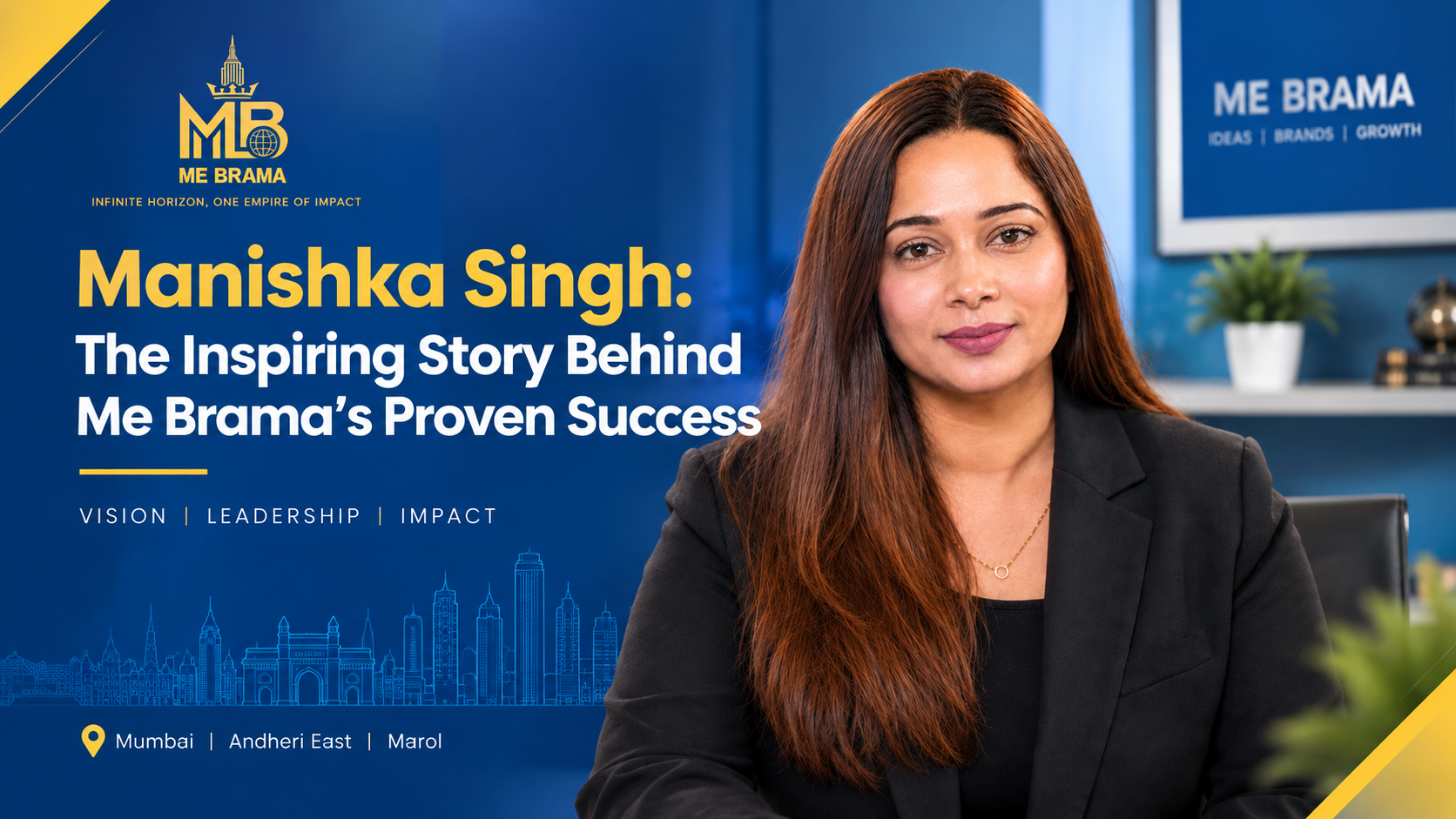
Manishka Singh is what today’s article is all about — here’s what Mumbai business owners need to know.
Running a small business in Mumbai means wearing a dozen hats at once — and digital marketing often ends up at the bottom of the priority list, done in spare moments between everything else. Manishka Singh, founder of Me Brama, has spent years working closely with small business owners across Andheri East, Marol, and greater Mumbai, and has seen firsthand which digital marketing habits actually move the needle — and which ones just waste time and money.
Here, we’ve compiled her top practical tips for small business owners who want real results without needing a corporate-sized marketing budget.
1. Fix Your Google Business Profile Before Anything Else
Manishka’s first piece of advice for almost every small business owner is the same: get your Google Business Profile in order before spending a single rupee on ads. A complete, accurate, actively updated profile — correct hours, real photos, prompt responses to reviews — often does more for local visibility than an expensive ad campaign layered on top of a neglected profile.
2. Don’t Chase Every Platform — Pick One and Go Deep
A common mistake small businesses make is trying to maintain a presence on every social platform at once, spreading themselves too thin to be effective anywhere. Manishka recommends choosing the one or two platforms where your actual customers spend time — often Instagram for D2C and food businesses, or LinkedIn for B2B and manufacturing businesses in areas like Marol — and building real consistency there before expanding.
3. Reviews Are Marketing, Not an Afterthought
For local businesses — restaurants, clinics, boutiques, service providers — genuine customer reviews are one of the most powerful (and cheapest) marketing assets available. Manishka encourages small business owners to build a simple habit of asking happy customers for a review right after a positive interaction, rather than treating reviews as something that happens passively.
4. Track What Actually Matters, Not Just Likes and Followers
It’s easy to get distracted by vanity metrics — follower counts, likes, impressions — that feel good but don’t necessarily translate into revenue. Manishka’s advice is to always tie marketing activity back to business outcomes: calls received, form submissions, walk-ins, or actual sales. A smaller, more engaged audience that converts is worth more than a large, passive one that doesn’t.
5. Local SEO Beats Broad SEO for Most Small Businesses
Rather than trying to rank for broad, highly competitive terms, Manishka recommends small businesses focus on hyperlocal search terms — combining what they offer with their specific neighbourhood, like “Andheri East” or “Marol.” These searches have lower competition and much higher buying intent, since the person searching is often ready to visit or call immediately.
6. Invest in Website Speed Before Website Design
It’s tempting to obsess over how a website looks, but Manishka points out that a beautiful website that loads slowly will lose customers before they even see the design. For small businesses with limited budgets, prioritizing a fast, simple, mobile-friendly website usually delivers better results than an elaborate but slow one.
7. Remarketing Is the Small Business’s Best Friend
Most website visitors don’t convert on their first visit — but many are still interested. Manishka recommends small businesses set up basic remarketing campaigns early, so that people who’ve already shown interest keep seeing the brand across social media and search, gently nudging them back toward a purchase decision without needing an entirely new audience each time.
8. Content Doesn’t Need to Be Perfect — It Needs to Be Consistent
Small business owners often delay posting content because it doesn’t feel “professional enough.” Manishka’s advice is the opposite: consistency beats perfection. A steady stream of genuine, useful content — before-and-after photos, customer questions answered, behind-the-scenes glimpses — builds more trust over time than occasional, highly polished posts.
9. Understand Your Competitors’ Weaknesses, Not Just Their Strengths
Rather than simply copying what competitors are doing, Manishka encourages small business owners to look for gaps — questions competitors aren’t answering, complaints showing up in their reviews, or search terms they’re not ranking for. These gaps are often the fastest path to standing out in a crowded local market.
10. Know When to Bring in Help
Perhaps the most important tip: recognize when digital marketing has outgrown what you can manage alone alongside running the actual business. Many of Me Brama’s clients came to Manishka’s team after reaching exactly this point — where the potential was clear, but the time and expertise needed to execute consistently wasn’t available in-house.
Putting These Tips Into Practice
These principles aren’t theoretical — they reflect how Me Brama actually approaches client work across Andheri East, Marol, and Mumbai, whether the client is a D2C brand, a restaurant, a manufacturing business, or a healthcare clinic. The agency’s own track record — 76+ projects delivered, 8,500+ leads generated, and a strong client retention rate — reflects these same fundamentals applied consistently over time.
11. Don’t Underestimate the Power of a Simple, Fast-Loading Website
Manishka often sees small Andheri East business owners investing heavily in elaborate website design while neglecting basic loading speed and mobile usability. A simple, fast, mobile-friendly website that clearly states what a business offers and makes contacting them effortless will consistently outperform a visually elaborate but slow-loading site. For most small Marol businesses, a straightforward website with clear calls to action delivers more conversions than an expensive design that takes seconds too long to load on a customer’s phone.
12. Build an Email List Even Before You Think You Need One
Even small businesses without a formal e-commerce operation benefit from building an email list early – collecting emails from customers, inquiries, and website visitors from day one, well before a formal email marketing strategy is in place. Manishka’s advice is simple: capture the contact whenever you reasonably can, since building an audience of previous customers and interested prospects becomes an increasingly valuable owned asset that doesn’t depend on any single platform’s algorithm.
Every Andheri East business owner I talk to eventually says the same thing: I wish I’d started collecting customer contacts sooner. It costs nothing to start today, and it’s one of the few marketing assets you fully own, says Manishka Singh, Founder of Me Brama.
Frequently Asked Questions
Which of these tips should a brand-new Andheri East business tackle first?
Manishka recommends starting with Google Business Profile optimization and website speed, since these two fixes are typically free or low-cost and produce the fastest visible improvement in how easily customers can find and trust a new business.
How many of these tips should a business try to implement at once?
Manishka advises focusing on two or three tips at a time rather than attempting all twelve simultaneously, since sustainable, well-executed changes tend to outperform a rushed, scattered implementation of everything at once.
Why These Tips Work Together, Not Just Individually
Manishka is careful to point out that these twelve tips aren’t meant to be treated as a disconnected checklist – they reinforce each other in ways that compound over time. A fast, mobile-friendly website (tip 11) becomes far more valuable once local SEO (tip 5) is actually driving traffic to it. A consistent review generation habit (tip 3) strengthens the trust signals that local SEO depends on. And tracking the right metrics (tip 4) is what allows a small Andheri East business to know which of these efforts are actually working, rather than guessing based on gut feeling alone.
This interconnected nature is exactly why Manishka recommends building a realistic, sequenced plan rather than treating each tip as an isolated task to check off – the businesses that see the strongest results tend to be the ones that understand how these pieces reinforce one another.
Real Examples From Manishka’s Client Conversations
Manishka often references specific, anonymized examples from her conversations with Andheri East and Marol business owners to illustrate these tips in action. One small retail business owner had been paying for social media ads on three different platforms simultaneously, spreading a modest budget so thin that none of the campaigns had enough data to optimize effectively – a direct illustration of tip 2 in practice. Consolidating that budget into a single, well-optimized platform produced noticeably better results within weeks, simply by giving one channel enough resources to actually work.
Can these tips work for a business with a very limited marketing budget?
Yes – several of these tips, including Google Business Profile optimization, consistent review requests, and choosing one platform to focus on, require minimal or no budget at all, making them accessible starting points for even the most resource-constrained Andheri East small business.
A Simple Self-Assessment Before You Begin
Before diving into any of these twelve tips, Manishka suggests a quick honest self-assessment: which of these areas is your business weakest in right now? Rather than starting with whichever tip feels most exciting or trendy, identifying the genuinely weakest link – whether that’s an unclaimed Google Business Profile, a website that takes eight seconds to load, or a complete absence of any review-requesting habit – tends to produce the fastest, most meaningful improvement, since it addresses whatever is currently doing the most damage to the business’s digital presence.
What Happens When Small Businesses Apply These Tips Consistently
Manishka has watched enough Andheri East and Marol businesses apply these principles over time to see a consistent pattern emerge: the results rarely arrive as one dramatic breakthrough moment. Instead, small business owners typically notice a gradual, steady increase in inquiries and customer awareness over two to four months of consistent effort – a pattern that can feel discouraging in the early weeks when changes seem minor, but that compounds meaningfully by the time a business reaches the three or four month mark. Manishka’s consistent advice to business owners in this early stage is to trust the process and keep measuring, rather than abandoning a strategy prematurely because dramatic results haven’t appeared within the first two weeks.
Whichever tips you start with, treating them as a long-term operating habit rather than a one-time project tends to be what separates the Andheri East businesses that see lasting growth from those that try a few tactics briefly and give up too soon.
For business owners who’d rather have an experienced partner apply these principles directly to their specific business, that’s exactly the kind of hands-on support Manishka Singh’s team at Me Brama provides every day.
Small, consistent steps compound faster than most Andheri East business owners expect, especially once two or three of these tips start reinforcing each other.
Manishka and the Me Brama team remain a phone call away whenever that support makes more sense than going it alone.
Get Personalized Guidance From Manishka Singh’s Team
Every small business is different, and general tips can only take you so far. If you’d like a tailored digital marketing strategy for your specific business, Me Brama offers a free consultation to review where you currently stand and identify the highest-impact next steps — without unnecessary jargon or an unrealistic budget ask.